Profile of a Successful Green Entrepreneur: Andy Shallal, Busboys & Poets

Andy Shallal 3

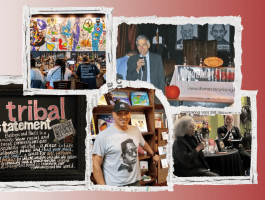
Anas “Andy” Shallal is an Iraqi-American artist, activist and restaurateur, who is perhaps best known for owning and operating Busboys and Poets in Washington, D.C.  Busboys and Poets is a popular green restaurant: it has plenty of vegan alternatives and organic beer and wines on its menu, and uses recyclable products and wind energy in its operations.  But the venue is so much more than a restaurant.  It houses a fair trade market and bookstore and a space for music shows and poetry slams, and frequently displays local artists’ works.

As Mr. Shallal puts it: “Busboys and Poets is a labor of love.  It’s a culmination of all my passions under one roof… a restaurant/bookstore/performance space with a progressive political agenda.”

Since the first location opened in the U Street corridor in 2005, Busboys and Poets has generated considerable support within the community, thanks to its focus on issues of social justice and peace.  Busboys and Poets has also opened two other locations in Washington, D.C., and last year grossed over $14 million in revenues.  By staying true to his socially responsible vision for Busboys and Poets, Mr. Shallal has managed to provide several D.C.-area communities with a friendly gathering place where they can enjoy good food and great dialog.

How was your commitment to social justice initially received within the surrounding community?
People were initially skeptical…[but] once we opened, people realized that we provided more than just a place to buy good food…[we were] also a community space that honors and enhances the surrounding community and its history.

Given some of the initial resistance you encountered, why did you insist on starting a business with such progressive aims?  In retrospect, do you think it would have been easier – or more successful – had you opened a restaurant without the prominent commitment to social justice?

To me a business that is not grounded in social justice and community is a business not worth having.  I cannot imagine doing business just for financial profit.

Why have you chosen restaurants to effectuate social change?
Everyone eats!  A restaurant or coffee shop is a watering hole for the community.  It’s where people connect and share with one another.

What were some of the challenges you faced when starting a green business?
Believe it or not, it’s the availability of products and ease of procurement.  For instance it was nearly impossible to get green cleaning products.  We had to educate our purveyors on what green means.

To what resources did you turn when you were forced to confront these challenges?  How did you overcome them?
Once we made the commitment to go green, we gave our suppliers an ultimatum.  Either come along for the ride, or we’re leaving them behind.  They came along!

When you initially were looking for startup capital for the first Busboys and Poets, you spurned traditional banks, and went through a local, black-owned bank (Industrial Bank) in order to secure funding.  Why did you choose to acquire funding through Industrial Bank?  Were they able to offer better terms, or was it part of your commitment to do business locally?

I wanted a local bank with a history in this community.  Industrial Bank provided such a connection.  The terms were similar to what I would have gotten elsewhere, but it was important to stay local.

Do you think an entrepreneur today would be able to get similar financing?
I doubt it.  Entrepreneurs are facing unprecedented obstacles in obtaining financing.  I know this fact firsthand.  I recently went to get additional financing for expansion and was told that I needed my home for collateral.  I found that absurd having had such a long track record and very good credit.  I can just imagine what a start-up would have to do.

How surprised have you been at the success of Busboys and Poets?  What do you consider to be its critical success factors?

Busboys and Poets’ success lies in the fact that it is a welcoming place that is grounded in community.  It provides a much needed service for a gathering space.  We have managed to create a great deal of alliances with local organizations that use us for their meetings and gatherings.

Andy Shallal 1

How did you reach the decision to utilize recyclable products and wind energy for the store?  How have these choices affected your business operations?
It was at the center of our mission.  People immediately know what we are all about the minute they enter our space.  We did not try to be everything for everyone – we definitely have a niche and we adhere to it.

What challenges do you face today?  How are you addressing them?  Have you been able to turn to other green businesses and organizations for help?
My biggest challenge is trying to create coalitions within my industry to create buying cooperatives that will help to address the cost issues for green products.  Unless the costs come down it will be very hard to convince the neighborhood carryout to switch to containers that cost 3 or 4 times more than Styrofoam, for instance.

If you could change one thing about the green business landscape right now, what would it be?
Make it less elitist and more accessible to ordinary citizens.  Right now green is synonymous with costly.  This needs to change.  It should be more cost effective to operate a green business, yet green businesses face higher costs.

What business opportunities do you think exist for aspiring entrepreneurs in the green marketplace?
Better distribution mechanisms for sustainable and local foods would fill the gap for such a need.

Mr. Shallal, you’ve been quoted elsewhere as saying that when you first started Busboys and Poets, you would be surprised if it made money, and that you planned to keep the place running, even if it was barely breaking even. Should other green entrepreneurs have such humble aspirations for their startups?  Do they need to temper their return expectations if they have similarly strong social responsibility commitments?

I think you should dream big and act small.  Very successful entrepreneurs rarely start an enterprise to make money.  Yet most of them do.  I tell any aspiring entrepreneur that if their motivation is primarily money centered, they will either fail or be rich and miserable.

Share this article

NPR Finds Right-Wing Crank to Spit on Howard Zinn’s Grave

David Horowitz in ATC obituary with

substance-free attack

When progressive historian Howard Zinn died on January 27, NPR’s All Things Considered (1/28/10) marked his passing with something you don’t often see in an obituary: a rebuttal.

After quoting Noam Chomsky and Julian Bond, NPR’s Allison Keyes turned to far-right activist David Horowitz to symbolically spit on Zinn’s grave. “There is absolutely nothing in Howard Zinn’s intellectual output that is worthy of any kind of respect,” Horowitz declared. “Zinn represents a fringe mentality which has unfortunately seduced millions of people at this point in time. So he did certainly alter the  consciousness of millions of younger people for the worse.”

Horowitz’s substance-free attack contributed nothing to an understanding of Zinn’s life or work, other than conveying that he’s disliked by cranky right-wingers.  (Horowitz has been best known in recent years for his race-baiting and Muslim-bashing–Extra!, 5-6/02; FAIR report, 10/1/08.)  He seems to have been included merely to demonstrate that NPR will not allow praise for a leftist to go unaccompanied by conservative contempt.

Needless to say, it is not the case that NPR has a consistent principle that all its obituaries be thus “balanced.” Take its coverage of the death of William F. Buckley, a figure as admired by the right as much as Zinn was on the left.  Upon his death in February 2008, NPR aired six segments commemorating him, none of which included a non-admiring guest.  In two segments, All Things Considered (2/27/08) presented the remembrances of Rich Lowry (Buckley’s successor at National Review), his son Christopher and his biographer Sam Tanenhaus.

One of the All Things Considered segments did include a soundbite of Noam Chomsky debating with Buckley: “No, I don’t believe that…. In fact I think that…” But what Chomsky did not believe was unclear, let alone what he actually thought.

Talk of the Nation
(2/27/08) featured admirer William Kristol, while Day by Day (2/27/08) had an extended interview with protegee David Brooks. Morning Edition (2/28/08) just quoted Buckley himself.

The celebration of Buckley culminated with Weekend Edition host Scott Simon (2/29/08), who turned the cause of death into a eulogy:  “Emphysema, such an unseemly thing for a man who was so often a breath of fresh air.”

In fact, there was much to criticize about Buckley, who was a supporter of, among other things, white supremacism in the U.S. South and South Africa, McCarthyism, nuclear war against China and the tattooing of AIDS patients’ buttocks (Extra!, 5-6/08). Reporting his death, however, NPR didn’t think it was worth bringing on a critic who would take a negative view. Why the same outlet took a different approach when the subject was an intellectual on the left rather than the right is perhaps something the NPR ombud could answer.

TAKE ACTION!


ACTION:
Please ask NPR ombud Alicia Shepard why All Things Considered brought on David Horowitz to trash the late Howard Zinn when NPR’s extensive coverage of William F. Buckley included no critical guests.

CONTACT:
You can contact NPR ombud through this web form, or call 202-513-3245.

Please post copies of your letters in the comments section on the FAIR Blog.

Share this article

Noam Chomsky, Naomi Klein and Alice Walker Reflect on the Death of Howard Zinn

Remembering the lifelong dissident and peace activist and historian, who joined many of the struggles for social justice over the past fifty years.

January 28, 2010 |
AMY GOODMAN: [Howard Zinn] died suddenly Wednesday of a heart attack at the age of eighty-seven.

After serving as a bombardier in World War II, Howard Zinn went on to become a lifelong dissident and peace activist. He was active in the civil rights movement and many of the struggles for social justice over the past fifty years.

He taught at Spelman College, the historically black college for women. He was fired for insubordination for standing up for the students. While at Spelman, he served on the executive committee of SNCC, the Student Nonviolent Coordinating Committee. After being forced out of Spelman, Zinn became a professor at Boston University.

In 1967 he published Vietnam: The Logic of Withdrawal. It was the first book on the war to call for immediate withdrawal, no conditions. A year later, he and Father Daniel Berrigan traveled to North Vietnam to receive the first three American prisoners of wars released by the North Vietnamese.

When Daniel Ellsberg needed a place to hide the Pentagon Papers before they were leaked to the press, he went to Howard and his late wife Roz.

In 1980, Howard Zinn published his classic work, A People’s History of the United States. The book would go on to sell over a million copies and change the way we look at history in America. The book was recently made into a television special called The People Speak.

Well, in a moment, we’ll be joined by Noam Chomsky, Alice Walker, Naomi Klein, Anthony Arnove. But first, I want to turn to a 2005 interview I did with Howard Zinn, in which he talked about his time as an Air Force bombardier in World War II.

    HOWARD ZINN: Well, we thought bombing missions were over. The war was about to come to an end. This was in April of 1945, and remember the war ended in early May 1945. This was a few weeks before the war was going to be over, and everybody knew it was going to be over, and our armies were past France into Germany, but there was a little pocket of German soldiers hanging around this little town of Royan on the Atlantic coast of France, and the Air Force decided to bomb them. Twelve hundred heavy bombers, and I was in one of them, flew over this little town of Royan and dropped napalm—first use of napalm in the European theater.

    And we don’t know how many people were killed or how many people were terribly burned as a result of what we did. But I did it like most soldiers do, unthinkingly, mechanically, thinking we’re on the right side, they’re on the wrong side, and therefore we can do whatever we want, and it’s OK. And only afterward, only really after the war when I was reading about Hiroshima from John Hersey and reading the stories of the survivors of Hiroshima and what they went through, only then did I begin to think about the human effects of bombing. Only then did I begin to think about what it meant to human beings on the ground when bombs were dropped on them, because as a bombardier, I was flying at 30,000 feet, six miles high, couldn’t hear screams, couldn’t see blood. And this is modern warfare.

    In modern warfare, soldiers fire, they drop bombs, and they have no notion, really, of what is happening to the human beings that they’re firing on. Everything is done at a distance. This enables terrible atrocities to take place. And I think, reflecting back on that bombing raid and thinking of that in Hiroshima and all the other raids on civilian cities and the killing of huge numbers of civilians in German and Japanese cities, the killing of 100,000 people in Tokyo in one night of fire-bombing, all of that made me realize war, even so-called good wars against fascism like World War II, wars don’t solve any fundamental problems, and they always poison everybody on both sides. They poison the minds and souls of everybody on both sides. We’re seeing that now in Iraq, where the minds of our soldiers are being poisoned by being an occupying army in a land where they are not wanted. And the results are terrible.

AMY GOODMAN: After returning from the war, Howard Zinn attended New York University on the GI Bill. He then received his master’s and doctoral degrees in history from Columbia University.

In the late ’50s, Howard Zinn moved to Atlanta to teach at all-black women’s school Spelman, where he became deeply involved in the civil rights movement. We’re joined now by one of his former students, the author and poet Alice Walker. She’s joining us now from her home in Mexico.

Alice, welcome to Democracy Now! So sad to talk to you on this day after we learned of the death of Howard Zinn.

ALICE WALKER: Thank you very much for inviting me to talk.

AMY GOODMAN: But talk about your former teacher.

ALICE WALKER: Well, my former teacher was one of the funniest people I have ever known, and he was likelier to say the most extraordinary things at the most amazing moments…

Read the full post here

Amy Goodman is the host of the nationally syndicated radio news program, Democracy Now!

Share this article

Do you have an idea for a blog post? Fill out our Blog Post Idea Form

    Open Mic Videos

    Andy - Owner/Muralist

    Back to top